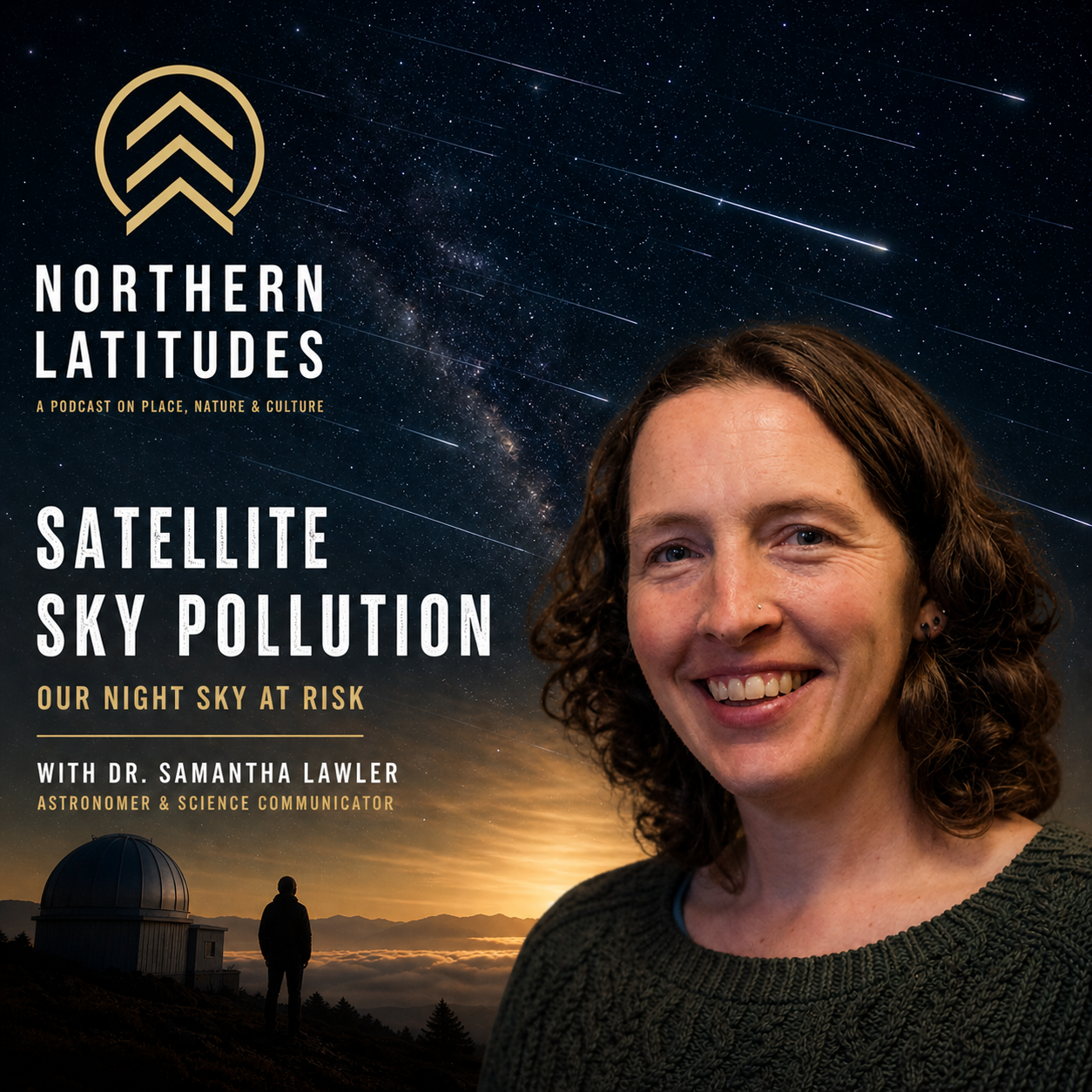
About Our Guest
Prof. Samantha Lawler is an astronomer at the University of Regina who studies the Kuiper Belt — icy bodies beyond Neptune — to understand how the solar system formed. She lives on a farm outside Regina under dark Saskatchewan skies and has emerged as one of Canada’s leading voices on satellite light pollution. She has an asteroid named after her.
What This Episode Is About
There are now more than 10,000 Starlink satellites in orbit. One company — owned by one billionaire — controls two-thirds of all satellites in space, and the number is still climbing. Proposals are on file for AI data centres and giant reflective mirrors in orbit. One request alone asks for a million satellites. In this conversation, Prof. Lawler explains what this actually means: a night sky that is measurably changing, an atmosphere being chemically altered by thousands of burning satellites each year, and a collision risk that is compressing faster than most people know.
Key Topics
• The scale: 10,000+ Starlinks in orbit, permission for 42,000. One company owns two-thirds of all satellites — a shift that happened in six years.
• The crash clock: Lawler’s research calculates how long before a collision becomes likely if satellites lose the ability to manoeuvre. Nine months ago: 5.5 days. January: 3.5 days. Now: 3 days — and shrinking.
• Kessler Syndrome: A runaway chain of collisions that could make low Earth orbit unusable for generations. The movie Gravity was not that far off.
• Atmospheric pollution: Satellites burn up in the upper atmosphere, depositing metals — especially aluminum — as vapour. Alumina can contribute to ozone depletion. Space has no environmental regulations.
• The night sky: Already ~10% brighter due to satellite numbers and debris. Human cultures have looked up at these patterns for as long as we have been human.
• The rural internet dilemma: Both host and guest used Starlink during this recording. The need is real — but relying on a foreign billionaire-owned monopoly for rural connectivity is not a solution. Governments need to invest in ground-based infrastructure.
Is There Hope?
Yes — cautiously. OneWeb (800 satellites) and Amazon Kuiper (2,000) prove the service can be delivered with far fewer objects in orbit. The engineering problem is solvable. The political will is the harder part.
What You Can Do
• Contact your elected representatives at federal, provincial, and local levels — demand investment in rural broadband infrastructure.
• Support dark-sky initiatives in your region.
Links & Resources
• Prof. Samantha Lawler — University of Regina
• Lawler on Mastodon: @sundogplanets
• International Astronomical Union on satellite constellations: iau.org
• Dark Sky Association: darksky.org