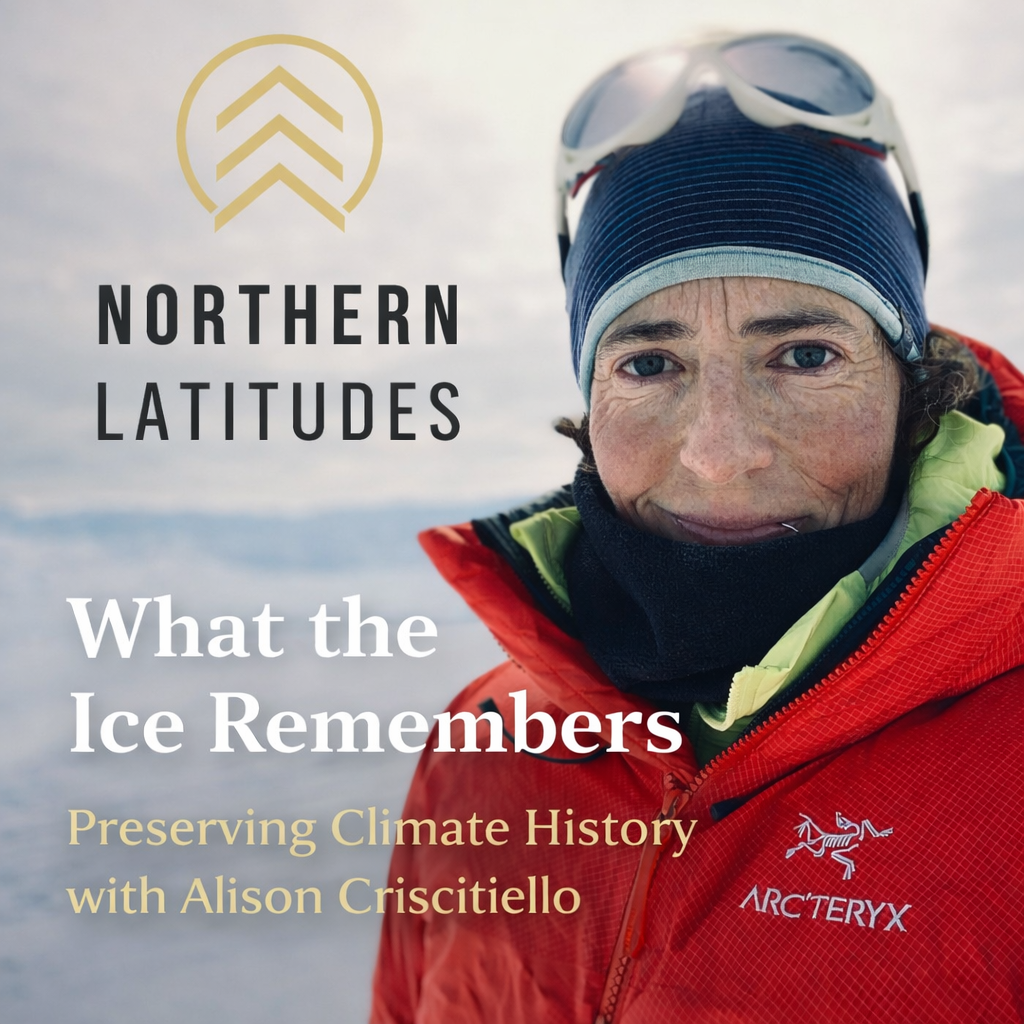
Preserving Climate History with Alison Criscitiello
Ice is one of the planet’s most faithful historians. Layer by layer, it records volcanic eruptions, atmospheric chemistry, temperature shifts, and traces of human activity stretching back tens of thousands of years.
In this episode of Northern Latitudes, Bill Ault speaks with Alison Criscitiello, Director of the Canadian Ice Core Lab at the University of Alberta, about what ice cores reveal.
Beyond the science, this conversation explores the human side of polar research. Alison reflects on building a career in remote, high-latitude field science as a queer woman in a discipline that has not always been welcoming, and why visibility and inclusion matter for the future of climate science.
In This Episode
- What ice cores are and how scientists extract them
- How ice preserves a detailed record of Earth’s atmosphere
- Why the Arctic and high latitudes are warming faster than the rest of the planet
Key Takeaways
- Ice cores are not projections; they are direct physical records
- Climate change is already visible in the planet’s deepest archives
- Who does science—and who is supported to lead—shapes what we learn
About the Guest
Alison Criscitiello is the Director of the Canadian Ice Core Lab at the University of Alberta. Her work focuses on ice core science, climate reconstruction, and the preservation of irreplaceable polar climate records.
Further Reading & Links
- Canadian Ice Core Lab – University of Alberta
- https://www.ualberta.ca/en/science/research-and-teaching/research/ice-core-archive/index.html
Keywords
climate changeAlison Criscitielloice cores